


Electricity does not always cost the same throughout the day. Under time-of-use (TOU) and other time-varying rates, utilities charge different prices depending on when electricity is consumed. Higher rates typically apply during periods of high demand, most often in the afternoon and early evening, according to the U.S. Energy Information Administration. That demand creates higher costs for grid electricity.
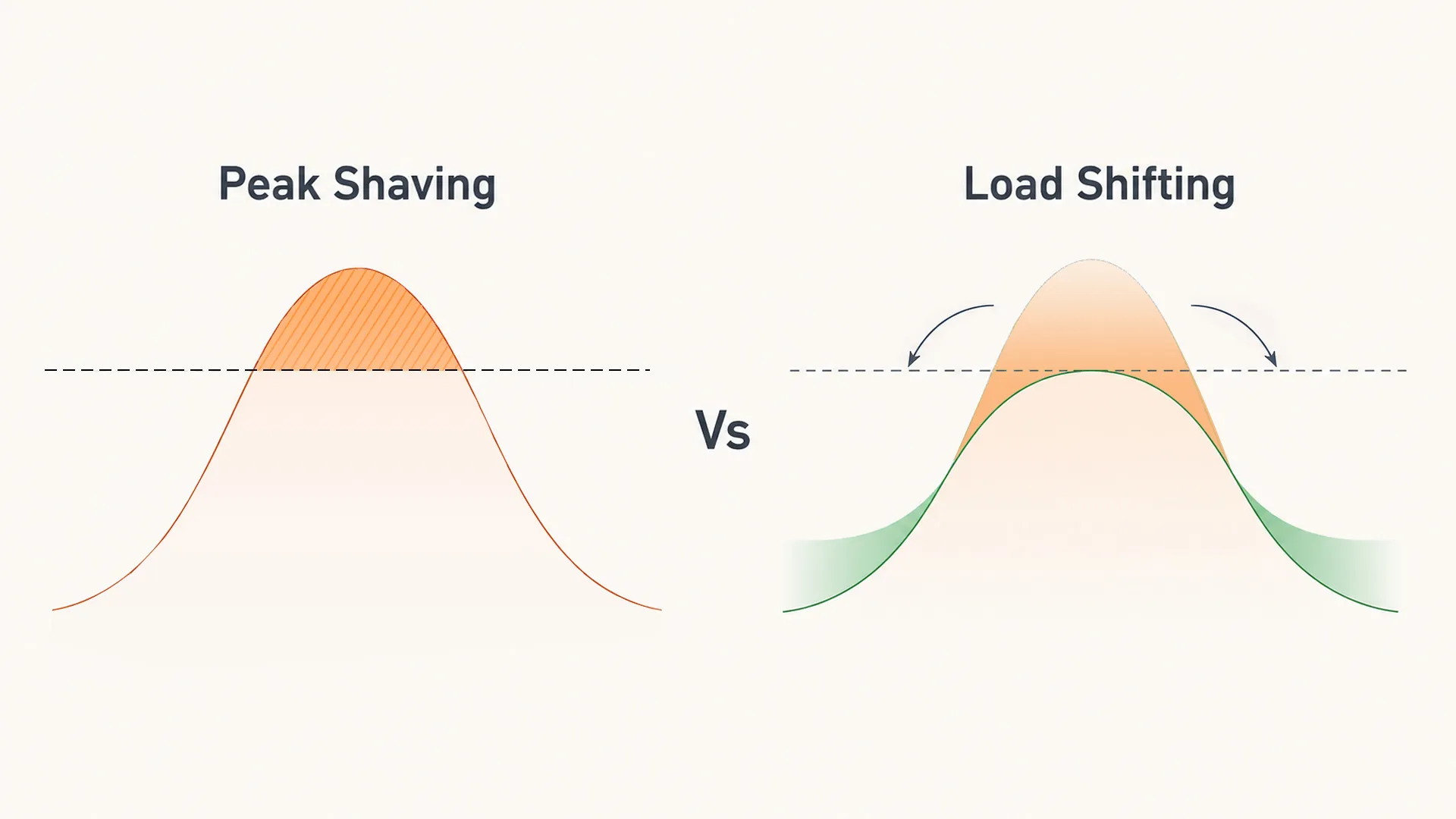
For homeowners seeking to reduce electricity costs, peak shaving and load shifting offer two different approaches. Peak shaving reduces how much power a home draws from the grid during high-demand intervals, while load shifting moves electricity consumption, or the source supplying that consumption, from higher-cost periods to lower-cost ones. Both strategies can help slash electricity bills, but they generate savings in different ways.
What Is Peak Shaving for a Home?
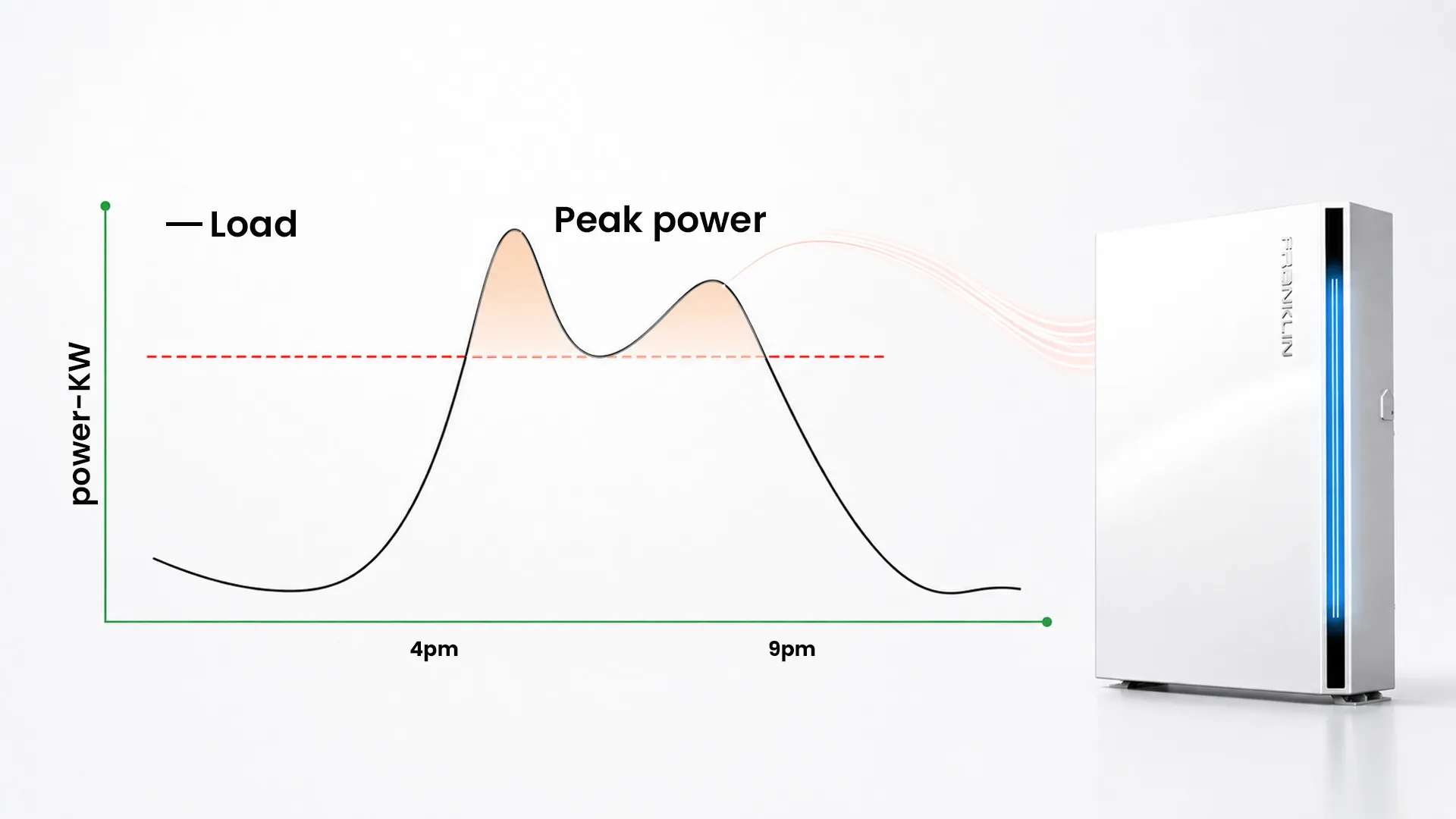
Peak shaving reduces the amount of power a home draws from the grid during periods of sharply rising electricity demand. Home batteries, rooftop solar, and intelligent load management can be leveraged to supply household demand so the grid does not have to meet the entire peak.
For example, a FranklinWH System with a 15 kWh aPower battery can use stored energy when household demand spikes during an expensive peak-rate period. If appliances require 8 kW and the battery supplies 10 kW, the net draw from the grid falls to 0 kW. If this continues throughout the entire peak-rate window, the homeowner eliminates high-priced kWh from the grid while still operating the same household loads.
Importantly, peak shaving does not necessarily reduce the home's total electricity consumption. Instead, it reduces the portion of high demand that must be supplied by the grid. This can lower residential energy costs when household demand peaks overlap with expensive TOU periods.
Traditionally, peak shaving has been associated with commercial and industrial customers, whose electric bills may include demand charges based on their highest power demand in kilowatts (kW) in a defined period. Today, some residential tariffs also include demand charges. In these cases, shaving the highest grid-demand spike can provide an additional source of savings beyond reducing high-priced energy purchases.
What Is Load Shifting?
Load shifting focuses on when electricity is used. Instead of simply curtailing grid demand during a peak, it moves electricity-consuming activities from expensive or high-demand periods to lower-cost periods.
For example, EV charging can be scheduled around TOU rates to take advantage of cheaper off-peak electricity. Rather than charging an EV immediately after returning from work at 6 p.m., when electricity rates may be high, a homeowner may delay charging until midnight, when off-peak rates are lower. The EV consumes roughly the same amount of energy, but more of those kWh are purchased at a lower price.
A major drawback of manual load shifting is the need for ongoing homeowner intervention, such as remembering to delay, start, or reschedule loads as routines or electricity-rate periods change. Automated scheduling (e.g., appliances with smart settings) and intelligent energy management solutions can minimize this inconvenience.
Peak Shaving vs. Load Shifting: A Side-by-Side Comparison
Peak shaving curtails grid usage when it costs the most, while load shifting reallocates grid usage to times when it costs less.
| Peak Shaving | Load Shifting | |
| Main goal | Reduce high grid demand | Reduce high grid demand |
| What changes? | Amount of grid power drawn during a peak | Timing of consumption or grid purchases |
| Main residential benefit | Buy fewer expensive grid kWh when high demand overlaps with peak rates | Replace expensive peak-period energy with cheaper off-peak or stored solar energy |
| Typical home energy system action | Battery charges during the day or off-peak hours and discharges when demand spikes | Directly powers shifted loads from solar or cheap off-peak grid power |
| Typical appliance strategy | Battery reduces the grid's share of simultaneous loads | Flexible loads operate during cheaper hours |
| Best suited to | Homes with large simultaneous loads or demand charges | Homes on TOU rates with flexible, schedulable loads |
| Does total home consumption necessarily fall? | No | No |
A Home Energy Management System with Battery Storage Supports Both Strategies
A home energy management system (HEMS) that includes battery storage can coordinate energy supply and household loads to support both peak shaving and load shifting. The FranklinWH System stands as the pinnacle of home energy management and battery storage solutions.
A FranklinWH System with a single aPower battery provides 15 kWh of usable capacity and 10 kW of continuous output, giving it enough capacity and power to support major household loads while shaving peak grid demand.
The system also delivers enterprise-level power quality, ensuring stable household operation without disruptive power fluctuations. With 185 A LRA load-start capability, the system is designed for demanding household loads, capable of starting a 5-ton A/C and more.
For load shifting, Smart Circuits enable granular control over individual energy-intensive household loads. A homeowner uses Smart Circuits to create customized schedules for appliances such as EV chargers or air conditioners, allowing them to automatically run during lower-cost off-peak hours instead of being manually managed.
With a 15-year or 60 MWH throughput battery warranty and reliability-focused design, the FranklinWH System is built to sustain these energy-management benefits over the long term, helping homeowners continue reducing expensive grid purchases and accumulating savings year after year, making it not just an upfront expense, but an investment with profitable financial returns.

Conclusion
Peak shaving and load shifting address different aspects of home energy management, but together they give homeowners greater control over when and how they rely on the grid. With an intelligent energy management and battery storage solution such as the FranklinWH System, these strategies can work in tandem to improve energy flexibility and efficiency, reduce exposure to costly rate periods, and deliver robust long-term savings.
