



The FranklinWH System combines whole-home energy management with a 15 kWh aPower battery to provide long-lasting power backup, keeping your entire home running when the grid goes down. High storage capacity, strong power output, enterprise-level power quality, and a 15-year or 60 MWh aPower warranty position the system as a robust solution for strengthening home energy resiliency.
However, it is time to break the myth that home battery storage exists only for power backup. Day-to-day, a home energy system with battery storage can store excess solar energy for use after sunset and shift grid consumption away from expensive peak periods to lower-cost hours, creating ongoing opportunities to slash electricity bills through energy arbitrage. Battery storage is therefore not simply emergency equipment that sits idle until the next blackout. It’s a long-term value-generating asset.
Premium solutions, such as the FranklinWH System, offer more than peace of mind during storms. They produce significant economic benefits through intelligent daily energy optimization while protecting your home when you need it most.
So, how much could the FranklinWH System save you over 15 years?
How the FranklinWH System Helps Save on Your Electric Bills
The FranklinWH System helps cut energy bills by optimizing energy consumption in response to time-of-use (TOU) tariffs, under which electricity prices fluctuate throughout the day. The system’s advanced energy management software intelligently coordinates the flow of solar, battery, and grid electricity based on household demand and electricity pricing.
During the day, the system prioritizes solar energy to power the home while storing surplus generation in the battery for peak evening use. When solar production is low or unavailable, it charges the battery with lower-cost grid electricity during designated off-peak hours, which may occur overnight. The stored energy is then shifted to on-peak periods to offset the steep cost of electricity purchased from the grid. Energy savings are achieved by exploiting the price differentials in time-varying rates.
The FranklinWH System can also schedule energy-hungry appliances connected through Smart Circuits, such as an EV charger, to automatically run after midnight when TOU tariffs typically offer the lowest overnight rates. All else being equal, the wider the gap between on-peak and off-peak prices, the greater the potential savings from this strategic energy arbitrage.
How Much Can You Save?
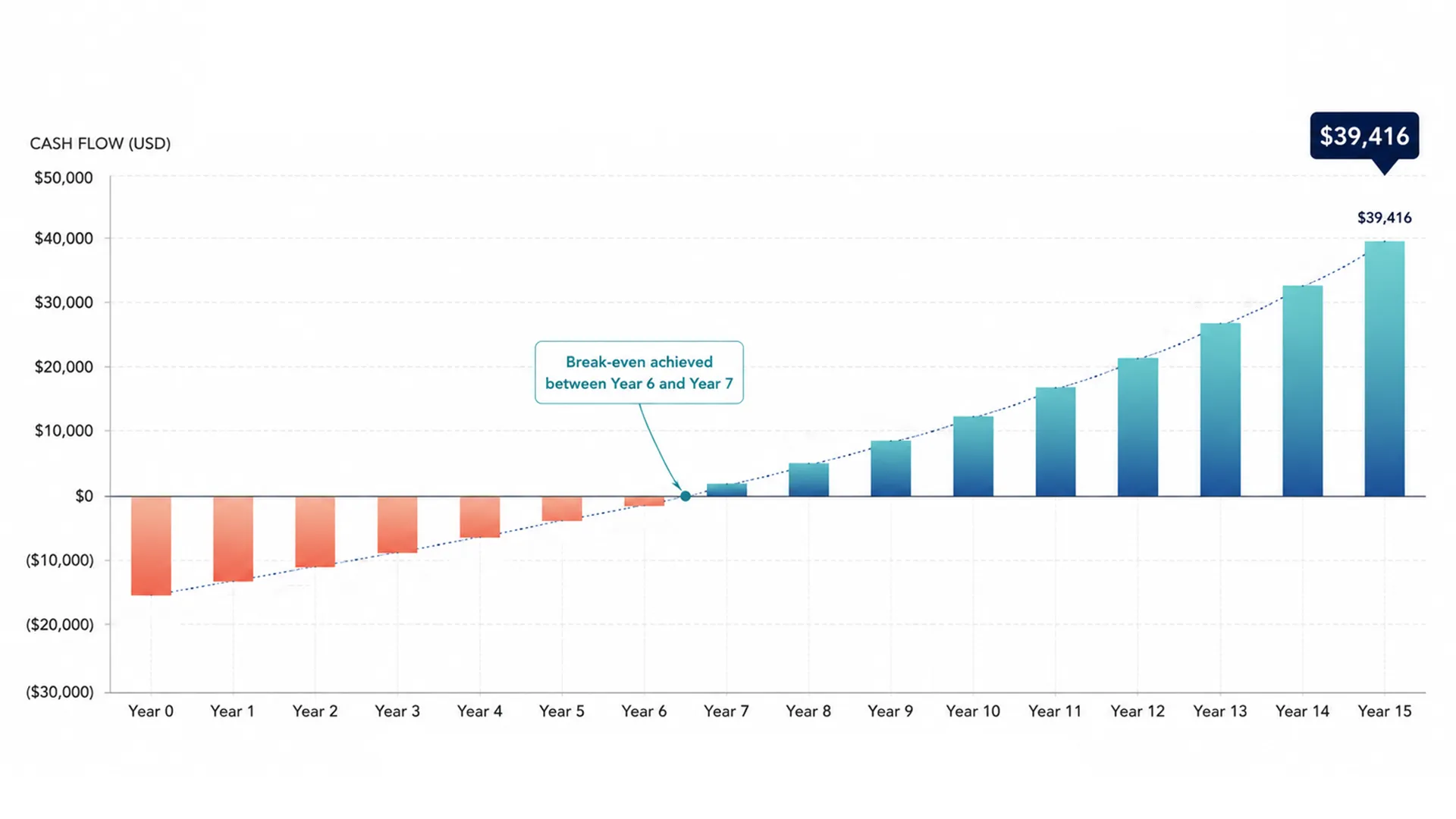
To estimate the FranklinWH System’s long-term financial value, the analysis applies the same system configuration, household energy usage profile, and tariff structure used in the first-year savings projection. It factors in the initial upfront cost, annual savings calculated from PG&E’s 2025 (year 0) electricity rates, a 9% annual utility-rate increase, and a 9% discount rate.
Under these assumptions, the FranklinWH System reaches payback in year 7, after which it begins generating positive cumulative returns. By year 15, it produces an estimated cumulative financial benefit of $39,416. After future savings are discounted to their present value, the system achieves an estimated net present value (NPV) of $10,505* over 15 years. The NPV shows how much an investment’s future savings are worth today after accounting for the system cost and adjusting 15 years of projected savings to today’s value.
*This estimate is based on simulations of real-world operating conditions using FranklinWH’s internal modeling software and is provided for reference only. Actual savings may vary depending on system capacity, location, available incentives, electricity tariff, and household energy consumption patterns.
Additionally, participation in an eligible virtual power plant (VPP) program can further increase the system’s financial return. By allowing battery stored energy to support the grid during periods of high demand, homeowners may earn additional revenue on top of their electricity-bill savings.
Long-Term Value Backed by Engineered Reliability
Long-term savings depend on the home energy management system continuing to perform reliably over its service life. The aPower battery in the FranklinWH System is engineered at the cell, pack, and product levels to manage mechanical stress, temperature variation, and electrical faults.
Long-Term Pack Integrity
The battery pack leverages steel straps that provide controlled elasticity, helping maintain stable compression to reduce pack deformation caused by natural cell expansion over time. This improves cell longevity and pack integrity, and ensures reliable electrical contact throughout the battery’s service life.
Cell Balancing and Thermal Management
The aPower combines active and passive cell balancing to ensure uniformity of cell voltage and state of charge (SOC) of all cells over time, helping prevent a weaker cell from limiting the usable capacity of the entire pack. Per-cell temperature monitoring provides more accurate thermal data, while the built-in dual cell heating blankets help maintain effective charging and discharging in cold conditions.
Multi-Layer Electrical and Physical Protection
Reliability is reinforced by putting battery cells, battery management system (BMS), and power conversion system (PCS) in separate compartments, reducing the likelihood that a fault in one area affects critical components in another. Separate charge and discharge circuits with independent switches allow the BMS, the control center of the battery, to immediately stop current flow when it detects a risk of overcharging or over-discharging.
Hardware protections, including fuses, MOSFET cut-offs, and dedicated short-circuit protection, provide an additional line of defense against abnormal voltage or current conditions.
Rigorous Tests
The aPower has undergone, and successfully conquered, a series of demanding environmental, mechanical, and electrical tests, including fire exposure, M8 seismic simulation, a 13-foot drop test, overcharge testing, and IP67 dust/water ingress testing. The results highlight proven safety and reliability of the FranklinWH System in response to electrical, mechanical, environmental, and fire-related stresses beyond normal operating conditions.
These engineered reliability features all work together to ensure the FranklinWH System delivers consistent performance, endures challenging operating conditions, and enables long-term value-generation throughout its 15-year warranted battery life. They are why FranklinWH’s RMA levels are the lowest in the industry. You have the security of knowing reliability matters and will minimize service charges over the life of the system.
Conclusion
The FranklinWH System is not simply backup equipment that gradually depreciates over time. By taking system reliability to the next level, it serves as a profitable long-term investment, delivering substantial financial return throughout its 15-year warranty period while significantly enhancing your home energy resiliency.
