


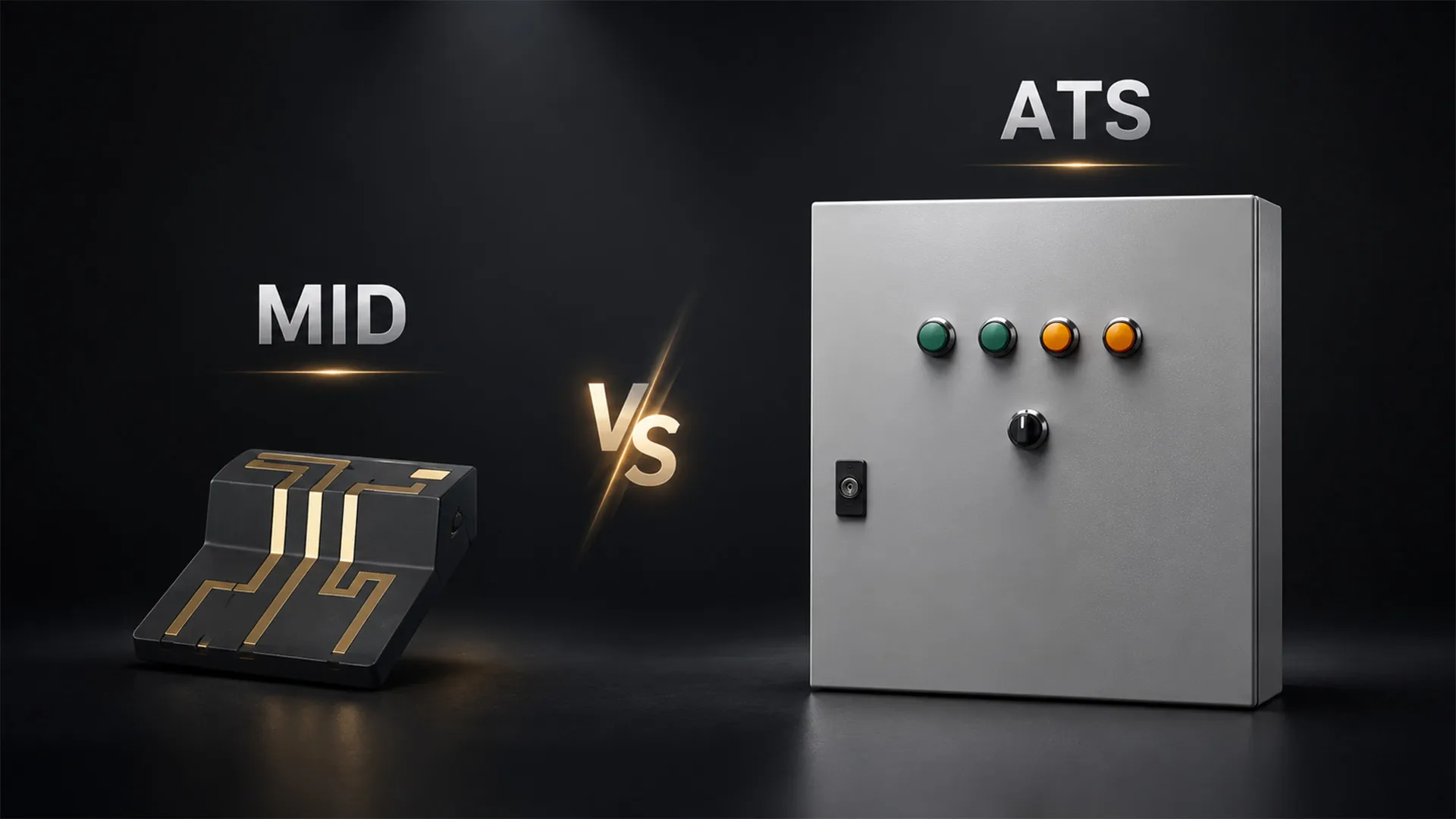
A Microgrid Interconnect Device (MID) and an Automatic Transfer Switch (ATS) both play important roles in maintaining safe, reliable backup power, but they originate from different needs. An MID is designed to connect or separate a whole microgrid, commonly an energy management and battery storage system, from the utility grid (known as island mode). An ATS, by contrast, has traditionally been used to automatically transfer loads between the utility and a secondary power source for backup, most commonly a standby generator. Today, however, ATSs are also increasingly used in grid-tied solar plus storage home energy systems.
Despite their different origins, MIDs and some modern ATS-based systems perform similar backup functions. Both can electrically separate an entire home energy system from the utility during an outage, helping prevent backup power from feeding onto the grid while allowing local energy resources to continue powering the home.
The differences ultimately lie in how the system is integrated and installed, affecting how many components are needed and how complex the wiring and installation will be. Understanding these differences can help homeowners choose the solution that best fits their home and backup needs.
What Is an MID?
An MID is the electrical interface that connects a microgrid to the utility grid. An MID’s grid-isolation relay or contactor is typically integrated directly into a system controller or compact meter collar device near the utility meter. When grid power is available, the MID keeps the microgrid connected so the home energy sources can interact with the grid, optimized by the central controller to slash energy costs. When the grid goes down, the MID disconnects the microgrid so local resources such as solar and batteries can continue powering the home safely in island mode.
The FranklinWH System is, for example, interconnected with the grid using an MID controlled by the aGate or Meter Adapter Controller (MAC), with the MID’s relay placed in the aGate or meter collar (with MAC). Under normal conditions, the MID’s sensing hardware monitors grid electrical conditions, while the energy management software inside the aGate/MAC controller interprets that data to determine when the grid connection should be switched. The MID’s grid relay then physically connects or disconnects the home microgrid from the utility.
What is an ATS
An ATS is traditionally used to keep loads powered when their normal power source fails. In a typical home backup system, the ATS monitors both the utility and an alternate source, usually a standby generator. If utility power goes down, the ATS’s dedicated controller automatically disconnects the loads from the grid and transfers them to the generator. When utility power returns and becomes stable, the ATS switches the loads back.
ATSs are now also used in some grid-tied solar-plus-battery systems. Instead of simply transferring loads to a generator, the ATS can isolate the home's solar-and-storage system from the grid during an outage, allowing it to operate as a backup microgrid.
In these systems, the ATS is often built in the form of a separate enclosure with its own transfer controller, while communicating with the system's central controller to coordinate backup operation. This design allows the ATS to handle grid switching while the higher-level system controls solar, battery, and other energy resources.
MID vs. ATS: Key Differences
The key difference between an MID and a conventional ATS lies in how they are designed to work within a home energy system. A conventional ATS typically transfers loads between two power sources: the utility grid and one alternate source, most commonly a standby generator. An MID, by contrast, is designed for a microgrid that may include multiple energy resources, such as solar, batteries, generators, vehicle-to-load (V2L), and controllable loads.
Some modern solar-plus-battery systems also use an ATS to separate the home microgrid from the utility during an outage. In this case, the key difference is often how the system is integrated.
In an MID-based solution such as the FranklinWH System with an aGate, the aGate centralizes switching control and whole-home energy-management functions within one multifunction device. By comparison, an ATS-based system may spread these functions across an independent ATS and a central controller. This distributed architecture can potentially result in increased equipment count and installation costs, but a separate ATS enclosure may provide greater flexibility in component selection and replacement, while an integrated MID may be more dependent on manufacturer-specific hardware for future upgrades or replacements.
That said, an ATS does not always require a separate enclosure. Its transfer function can also be built into a hybrid inverter. In these designs, the ATS and inverter work together to provide backup operation similar to MID-based systems.
Conclusion
A MID connects/disconnects a whole microgrid while a traditional ATS transfers loads between two discrete sources. In modern home energy management systems, however, both MID- and ATS-based architectures can allow home power backup with multiple local energy sources. The key consideration is how the system is integrated, controlled, and installed. Homeowners should take these factors into account to choose the architecture that best matches their home and energy needs. For instance, if a homeowner prioritizes system integration with few hardware components, the MID-based FranklinWH System with aGate and aPower S is a perfect choice.
