


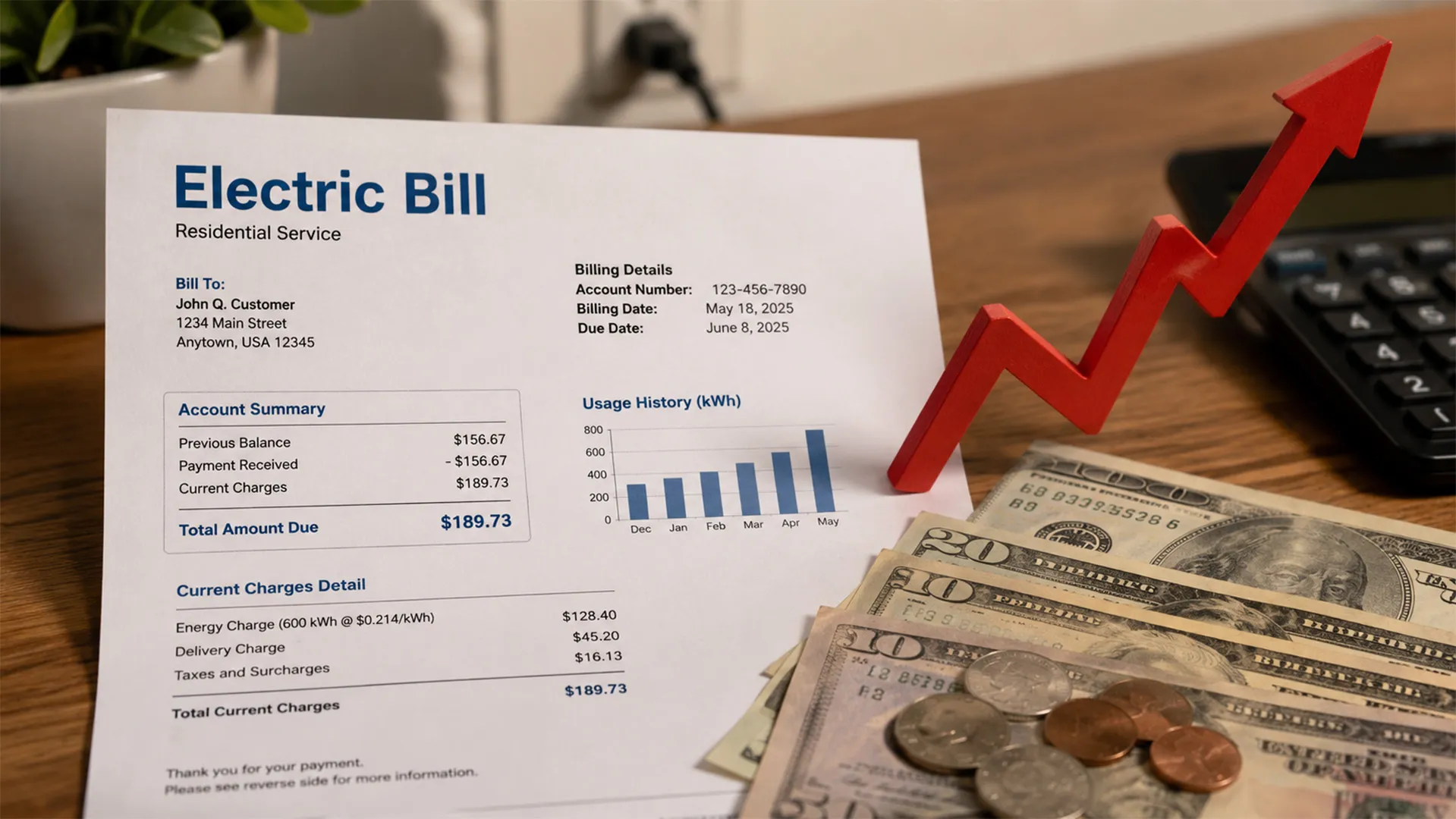
If your electricity bills seem to be climbing year after year, you're not alone. Rising fuel costs, extreme weather, aging grid infrastructure, higher transmission and distribution expenses, and growing electricity demand have all contributed to higher electricity prices in many parts of the United States. Meanwhile, seasonal changes, especially hot summers and cold winters, can significantly increase household energy consumption, resulting in even higher monthly bills.
How Much Are Electric Bills on Average?
The average U.S. residential electricity bill was $150 per month in 2025, up from $142 in 2024 and $137 in 2023, according to the U.S. Energy Information Administration (EIA). Monthly EIA data indicate that residential electricity prices remained elevated in 2026, meaning many households continue to face bills at or above this level.
Some parts of the country consistently pay much more than the national average. States such as Hawaii and Connecticut have average residential electric bills exceeding $200 per month, driven largely by high retail electricity prices.
What Is Included in an Electric Bill?
Before looking at the charges on your electric bill, it's helpful to understand how you're billed. Some homeowners are on a flat-rate plan, where the price per kWh stays the same throughout the day. Others have a time-of-use (TOU) rate plan, which charges higher rates during peak hours and lower rates during off-peak hours.
Regardless of your rate plan, understanding the components of your electric bill can help you identify what is driving your monthly costs.
Supply (Energy) charge: The cost of the electricity you use, measured by multiplying your kWh consumption by the electricity rate. If you're on a TOU plan, peak and off-peak usage is billed at different rates. This is typically the largest variable portion of your bill, accounting for 40–60% of the total.
- Delivery charge: The cost of delivering electricity to your home and maintaining the power grid. It typically includes a fixed monthly fee and a per-kWh delivery charge, and typically account for 40–50% of your bill.
- Customer charge: A fixed monthly fee that covers billing, meter maintenance, and account services. It applies regardless of how much electricity you use.
- Taxes and regulatory fees: State, local, or federal taxes, along with regulatory charges that support public services and utility programs. These costs generally account for less than 10% of an electric bill, although they can be higher in some states.
- Demand charge: Some TOU plans include a demand charge based on your highest power demand (kW) recorded during a specific period depending on the utility's rate designand often during on-peak hours. Because of this additional charge, these plans often offer lower off-peak energy rates.
- Public benefit charges: Charges that fund programs such as energy efficiency, renewable energy, low-income assistance, and state-mandated clean energy initiatives.
How to Calculate Electric Bill
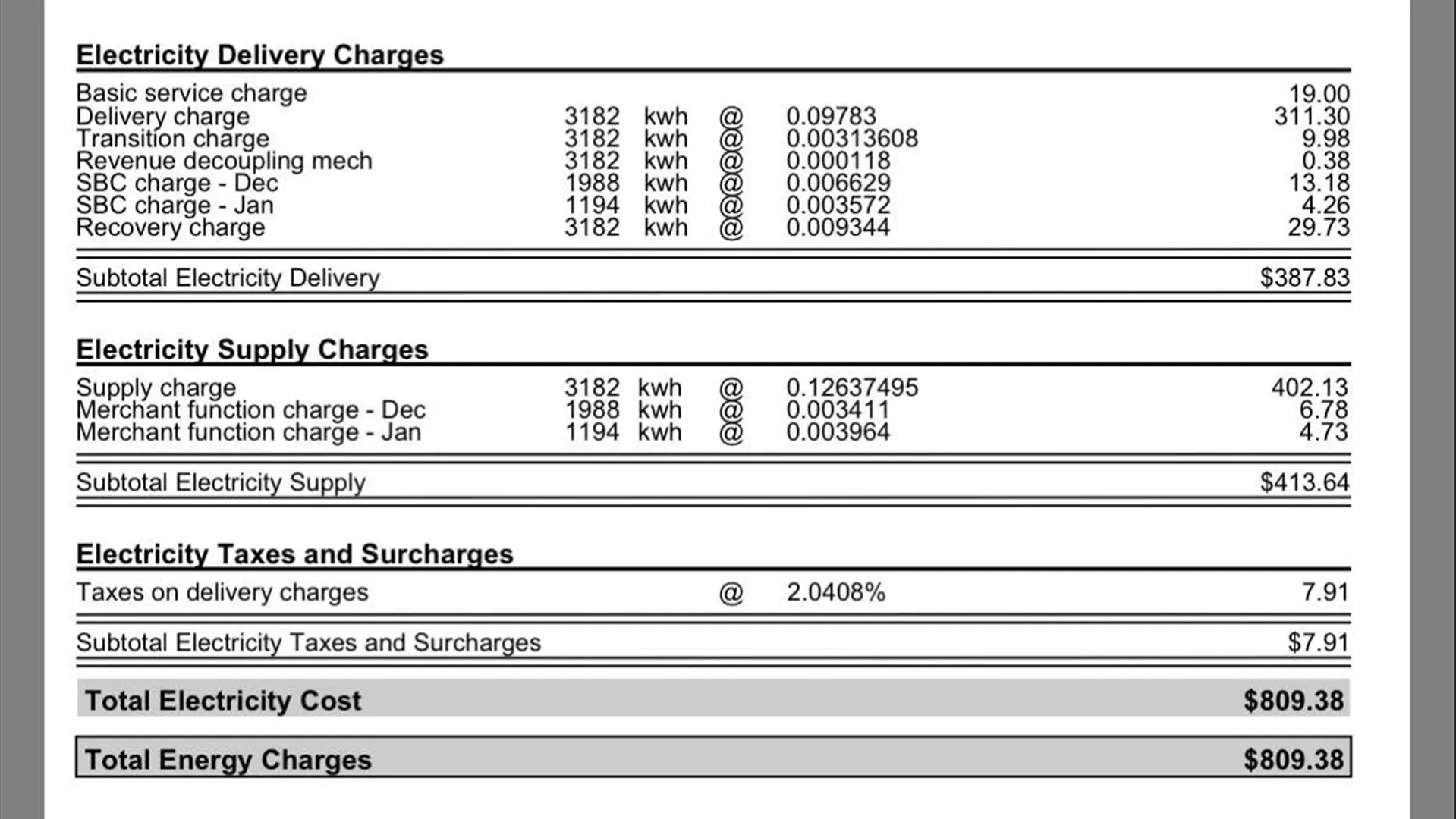
Your electric bill is calculated by adding up each charge included in your utility's rate plan. The example below uses Arizona Public Service (APS)'s Time-of-Use 4 p.m.–7 p.m. Weekdays with Demand Charge plan.
Assume a household uses 1,000 kWh per month, including 200 kWh during on-peak hours (4–7 p.m. weekdays), 800 kWh during off-peak hours, and a highest on-peak demand of 5 kW during the specified billing period.
The bill calculation would look like this:
- Energy charge: 200 kWh × $0.14227/kWh + 800 kWh × $0.05943/kWh =$75.99
- Delivery charge:1,000 kWh × $0.01242/kWh = $12.42
- Demand charge: 5 kW × $19.585/kW = $97.93
- Basic service charge: Approximately $14 per month
- Taxes, adjustments, and other fees: Estimated $40
Estimated monthly electric bill: Approximately $240*
*The cost is only for illustrative purpose. The actual number varies by rate plan and household usage profile.
Top 8 Ways to Reduce Your Electric Bill
Electricity billing is complex, and reducing your bill is not simply about using less electricity by cutting back on appliance use and sacrificing your comfort. Instead, homeowners can lower costs by strategically managing energy use, improving energy efficiency, taking advantage of time-of-use (TOU) rates, and reducing reliance on grid electricity with a home energy system.
1. Shift Energy Use to Off-Peak Hours
If you are on a TOU electricity plan, when you use electricity can be just as important as how much you use. Schedule energy-intensive activities, such as laundry, dishwashing, EV charging, and pool equipment operation, during lower-cost off-peak periods to avoid expensive peak charges.
2. Reduce Peak Demand
For electricity plans with demand charges, your bill can increase based on the highest amount of power your home draws during peak hours. Avoid running multiple high-power appliances at the same time, especially during peak periods, to reduce your demand-related costs.
3. Optimize Heating and Cooling
Heating and cooling often account for a significant portion of household energy use. Maintain HVAC equipment regularly, replace air filters, use programmable or smart thermostats, and adjust temperature settings when you're away to improve efficiency without compromising comfort.
4. Improve Home Insulation and Seal Air Leaks
A well-insulated home requires less energy to maintain a comfortable temperature. Sealing gaps around windows and doors and improving insulation can reduce heating and cooling losses, allowing your HVAC system to operate more efficiently.
5. Upgrade to Energy-Efficient Appliances and Lighting
Replacing outdated appliances with energy-efficient models and switching to LED lighting can reduce electricity consumption over the long term. Energy-efficient appliances may require a higher upfront investment but can help lower operating costs throughout their lifespan.
6. Reduce Standby Power Consumption
Many electronics continue drawing electricity even when they are not actively being used. Unplug unused devices or use smart power strips to reduce standby power waste from electronics such as TVs, computers, and chargers.
7. Generate Your Own Electricity with Solar
Solar panels allow homeowners to generate electricity on-site and reduce the amount of power purchased from the grid. By producing electricity during the day, solar can help offset household consumption and lower long-term electricity costs.
8. Consider a Home Energy Management System with Battery Storage
Solar panels can reduce electricity costs during the day, but that is intermittent and can't power your home at night. An advanced home energy management system with battery storage helps maximize your energy savings by intelligently coordinating solar, battery, and grid power.
The FranklinWH System is a prime example of such home energy solutions. It can:
- Prioritize solar energy to power your home while storing excess generation in the battery for nighttime use, reducing reliance on grid electricity.
- Enable energy arbitrage by charging the battery with lower-cost off-peak grid electricity when solar is unavailable and using that stored energy during expensive peak-rate hours.
- Automate energy use with Smart Circuits, which automatically shift energy-intensive appliances, such as EV charging, to off-peak hours without manual intervention.
- Monitor and optimize energy management through the FranklinWH App, providing real-time insights into energy production, consumption, battery status, and grid imports to maximize savings.
- Allow homeowners to enjoy absolutely free electricity after payback. The FranklinWH System offers a 15-year battery warranty and can pay for itself through electricity savings only in 5–7 years, depending on electricity prices, solar production, incentives, and household energy use.
- Allows you to live your normal life without the need to load shift as mentioned above.

Schedule a free consultation from FranklinWH to start your journey of maximum savings today!
