


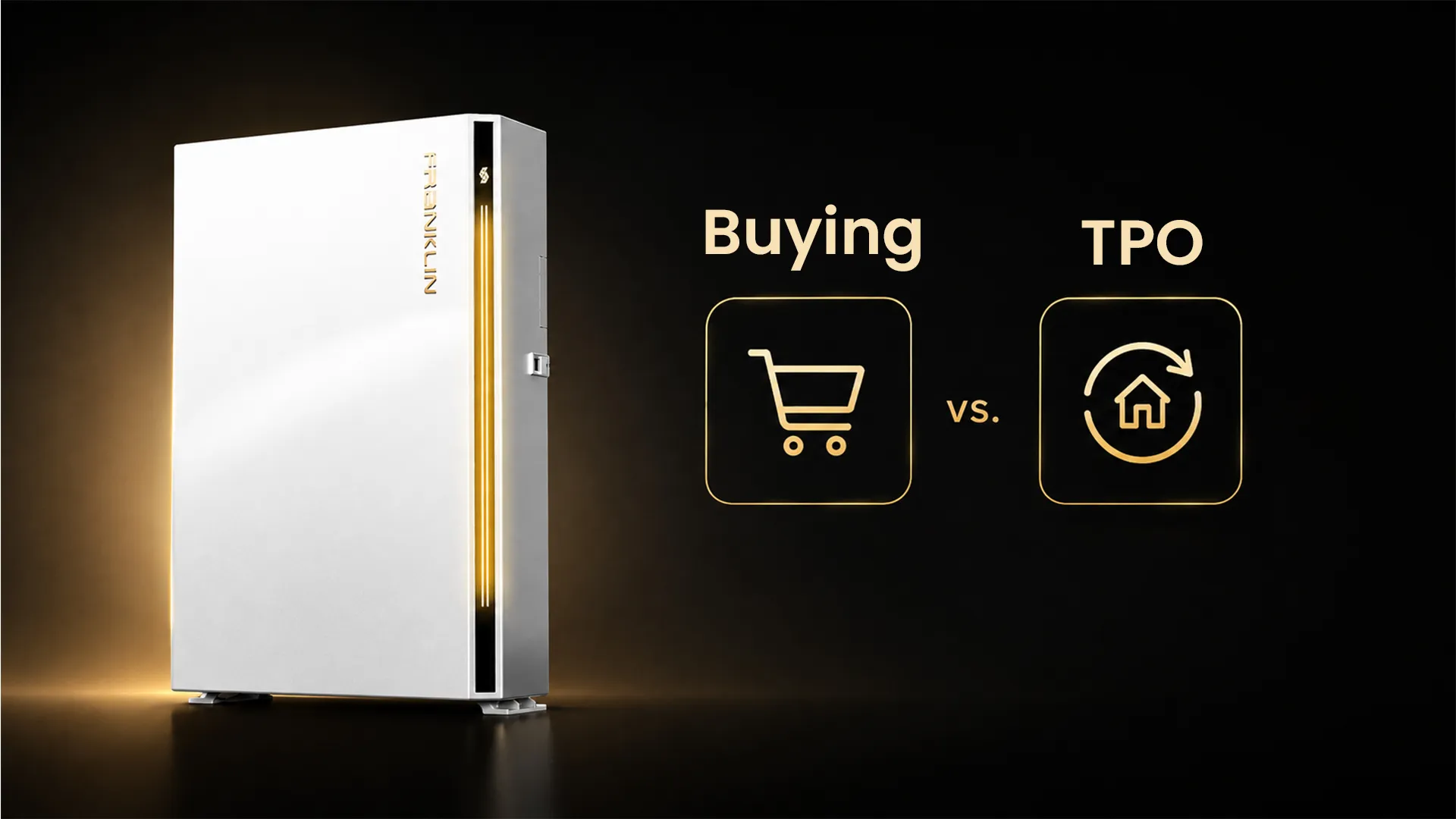
Installing a home energy system involves not just choosing the right solution. It is also about deciding how to pay for and own it. Homeowners can buy a battery outright or finance the purchase and retain ownership, or may choose third-party ownership (TPO), where a provider owns the system while the homeowner pays to use it, typically through a lease or power purchase agreement (PPA).
Both models come with their own advantages and trade-offs in upfront cost, long-term savings, maintenance responsibility, and system control. This article provides a comprehensive comparison of buying and TPO to help homeowners gain deeper insights into the options and make a smarter decision when adding a home energy management system with battery storage.
Long-Term Savings Potential
For homeowners focused on maximizing lifetime financial value, buying generally offers greater long-term savings than TPO. Once the initial purchase or financing costs are recovered, homeowners can continue to capture the entire savings generated by reduced electricity bills.
By comparison, TPO can significantly lower upfront costs and typically shifts maintenance responsibility to the third-party provider. However, because homeowners have to make ongoing lease or PPA payments that can typically reduce the homeowner’s share of the system’s lifetime financial benefits, traditional TPO arrangements generally offer homeowners less lifetime savings than direct ownership.
That said, the buying model’s advantage in long-term savings makes system longevity and reliability especially important.
Significant Economic Benefits with the FranklinWH System
As a premium home energy management and battery storage solution, the FranklinWH System is engineered for long-term reliability, with a reported RMA rate of approximately 0.2%, among the lowest in the industry. By setting a new benchmark of reliability standard, the FranklinWH System minimizes homeowners’ service demands and associated costs over the life of the system while reducing installers’ truck rolls and service burden after installation.
Combining reliability with advanced intelligent energy management software, the FranklinWH System strengthens the economics of system ownership. Depending on variables such as system capacity, electricity tariff structure, and household energy consumption, modeled scenarios indicate a FranklinWH System will achieve a payback period of approximately 5–7 years over its 15-year warranty period, and a net present value (NPV) of more than $10,000. NPV measures the value of an investment’s expected future financial returns in today’s dollars, accounting for the time value of money. The value illustrated above demonstrates the potential for an owned system to generate substantial financial value over time.
Choosing Ownership for Long-Term Value
For homeowners with sufficient available capital and who prioritize maximum long-term savings, buying a reliable home energy management and battery storage solution such as the FranklinWH System can offer stronger financial opportunities. TPO, meanwhile, may be more attractive to homeowners who emphasize lower upfront costs and provider-managed maintenance, even if that means giving up some long-term savings potential.
Power Backup During Outages
With a self-owned home energy system, homeowners generally have greater flexibility to decide how much stored energy to preserve for outages. With the FranklinWH System, homeowners can freely adjust their Backup Reserve or select Emergency Backup mode, which prioritizes charging the aPower batteries to 100% for an outage. This allows households in outage-prone areas to have long-lasting whole-home backup and strengthen energy security.
Under a TPO arrangement, battery operation may be more closely tied to the provider's program and contract terms. Some systems are optimized primarily for economic objectives such as peak shaving, TOU savings, or grid services, which means stored energy may be discharged during high-demand periods rather than held standby at 100% for emergency preparation.
Why Backup Capability Matters in Hurricane-Prone Areas
In hurricane-prone areas such as Puerto Rico, where severe storms can cause prolonged grid outages, homeowners need reliable backup capable of powering both essential and high-demand household loads. The FranklinWH System with an aPower battery provides whole-home backup with scalable 15 kWh of storage capacity, along with 15 kW peak output for 10 seconds and 185 A LRA to start demanding loads such as a 5-ton A/C. The black start technology automatically restarts solar charging when sunlight returns during a prolonged outage, replenishing the battery without manual intervention.
To endure harsh environmental conditions, the aPower features IP67 protection, C5 salt-spray resistance, and has been tested against M8 seismic simulation, ensuring consistent performance in stormy weather. The aPower is also built with robust internal architecture, such as steel bands holding the cells to reduce pack deformation, active balancing to maintain capacity uniformity of all cells over time, and per-cell monitoring for accurate thermal management, all working together to improve the system longevity and reliability.
Choosing Ownership for Backup
For homeowners with a strong need for greater energy resiliency, especially in places such as Puerto Rico, buying is a more compelling option. A self-owned FranklinWH System can be kept fully charged when severe weather approaches, ensuring that its available storage is dedicated first to keeping the home powered.
TPO remains an appealing option for homeowners looking to minimize initial expenses, but if outage protection is a primary goal, homeowners should closely review the contract to confirm how much backup reserve they control, whether the provider can discharge the battery for grid services, and what happens during prolonged outages, etc.
System Expansion for Growing Energy Needs
For homeowners whose energy needs may grow over time, self-ownership generally offers greater flexibility for system expansion than TPO. Owners can typically add solar panels, increase battery capacity, or integrate new energy resources and smart load management as household demand changes. That said, system expansion is subject to equipment compatibility and utility requirements, which apply regardless of ownership model.
With a third-party-owned system, however, modifications may further require the system owner's approval, and the provider may restrict what equipment can be added or how it is used.
FranklinWH System as a Flexible Home Energy Solution
The FranklinWH System is designed for flexibility rather than a fixed, one-size-fits-all configuration. Homeowners can start with the energy setup they need today and later add more battery storage, a generator, V2L capability, and Smart Circuits for granular load control, all without ripping out or replacing the existing system. This expandable architecture stands apart from more “cookie-cutter” solutions that can lock homeowners into the equipment and capabilities selected at the time of installation.
Choosing Ownership for System Scaling
For homeowners who place a high priority on long-term expandability and control, buying is generally the superior option. Self-ownership gives homeowners more freedom to adapt the system as their energy needs evolve, while TPO can introduce contractual restrictions. If homeowners prefer TPO to cut initial costs, make sure to carefully review expansion terms before signing.
Buying vs. TPO: Detailed Breakdown
Buying generally favors long-term savings, control, and system flexibility, while TPO is advantageous in lower upfront costs and provider-managed maintenance. The FranklinWH System supports both self-ownership and TPO, giving homeowners flexibility in how they add a home energy management and battery storage solution. The right choice ultimately depends on each homeowner’s budget, energy priorities, and desired level of control. The table below provides a detailed side-by-side comparison of the two ownership models.
| Ownership Models | Buying | TPO |
| System ownership | Homeowner | Provider |
| Upfront cost | Higher with cash; financing can reduce upfront cost | Little or no upfront cost |
| Long-term savings | Generally higher | Generally lower as provider retains part of the value |
| Maintenance | Manufacturer/installer warranty | Typically provider-managed |
| Backup control | Greater control over backup reserve and operating modes | May depend on provider or program terms |
| System expansion | Easy to add storage, solar, generators, and more | May require provider approval with contract limits |
| VPP & grid programs | Homeowners choose eligible programs and participation | Enrollment may be simpler, but dispatch and compensation depend on provider terms |
| Incentives | Homeowners can access eligible state, local, utility, and performance incentives | Providers receives incentives, with some value potentially passed on |
| Buying a new home | Greater ownership freedom | Preserve upfront capital, but adds ongoing payments |
| Renting out a home | The landlord is responsible for the system and service | Easier system management, but contract terms may affect tenants |
| Selling the home | Generally simpler | May require contract transfer, buyer qualification, or buyout |
| End of term | Homeowners keep the system | May remain provider-owned, be purchased, transfer to the homeowner, or be removed |
