


Why Reliability Is More Important Than Ever
In recent years, power outages have been hitting North America more often and lasting longer. From hurricanes in Texas to ice storms in the Midwest, millions of households have been left in the dark for hours, or even days. The risks go beyond inconvenience: refrigerated food can spoil, indoor crops can wither, and vulnerable residents may face serious safety issues.
Traditionally, homeowners have turned to gas or diesel generators for backup power, but the reality is that these machines have an unimpressive track record: industry data shows their actual backup takeover success rate is below 60%, due to cold starts, fuel shortages, and maintenance failures.
While residential energy management and battery storage systems offer an intelligent and cleaner alternative, here’s the major problem: there are no unified standards that measure whether they’ll actually keep the lights on when outages strike.
That’s where FranklinWH changes the game.
Borrowing Lessons from Data Centers
When it comes to backup reliability, no industry has higher standards than data centers. The ANSI/TIA-942 Reliability Tier System has become the global benchmark for quantifying uptime, helping cloud providers, banks, and hospitals measure their resiliency in clear, mathematical terms.
FranklinWH has adopted this framework for residential energy storage. Instead of vague promises, we now have a methodology to quantify backup power reliability using two transparent metrics:
- Reliability (%)
- Annual Downtime (hours, minutes, or milliseconds)
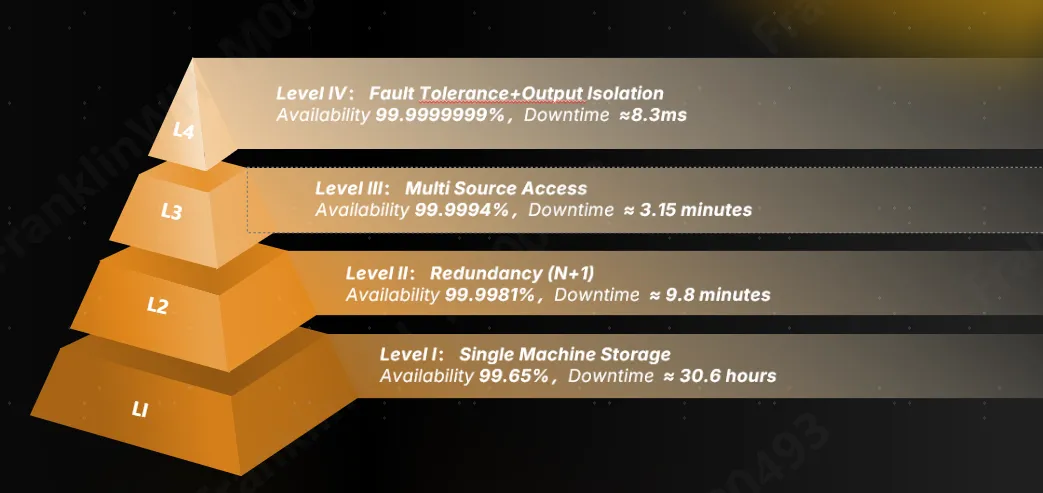
The result is a four-level scale, ranging from entry-level backup power at 99.65% reliability (about 30 hours of downtime per year) all the way to enterprise-grade 99.9999999% reliability (just 8.3 milliseconds per year).
How FranklinWH Relates to the Reliability Levels
By aligning with UPS architecture design from the data center world, FranklinWH Systems can now be evaluated using the same criteria applied to mission-critical facilities:
- Level I: Single-battery backup, basic resiliency, similar to Tier 1 data centers.
- Level II: Parallel multi-battery redundancy, minimizing single point of failure risk.
- Level III: Multi-source integration (eg., battery + generator), enabling continuous operation even during maintenance.
- Level IV: A highly redundant, fault-tolerant design with dual aGates and synchronization technology, achieving near–zero interruption power.
Each step up the ladder means higher fault tolerance, better switching, and greater assurance when outages happen.
The diagram below illustrates the reliability percentage and annual downtime for each level.
Real-World Reliability
This isn’t just on paper. The FranklinWH Systems have already proven their resiliency in the field:
During Hurricane Ian (2022), FranklinWH units in Florida stayed online after floodwaters receded.
In Hurricane Beryl (2024) and Hurricane Helene (2024), customers reported uninterrupted power even as millions of homes lost grid access.
Independent field testing backs this up: DNV data from 2023–2024 shows FranklinWH Systems operating with only a 0.30% failure rate, an exceptionally low number for residential hardware.
Why the Industry Needs a Consistent Standard
Right now, homeowners face a confusing market. Specs are fragmented, claims are inconsistent, and customers often end up choosing based on price rather than proven performance. By adopting quantifiable data center standards, FranklinWH is moving the industry toward:
- Clearer intuitive benchmarks that let customers compare apples to apples.
- Stronger design guidance for installers and manufacturers.
- Reliable protection for households depending on backup power in critical moments.
The Road Ahead
The clean energy transition has accelerated, but resiliency has lagged behind. FranklinWH is calling on manufacturers, installers, and homeowners to rally around a unified reliability grading system for residential storage.
By creating a common language of quantified reliability, we can ensure backup power systems live up to their promise: keeping homes safe, connected, and resilient, no matter what happens to the grid.
