


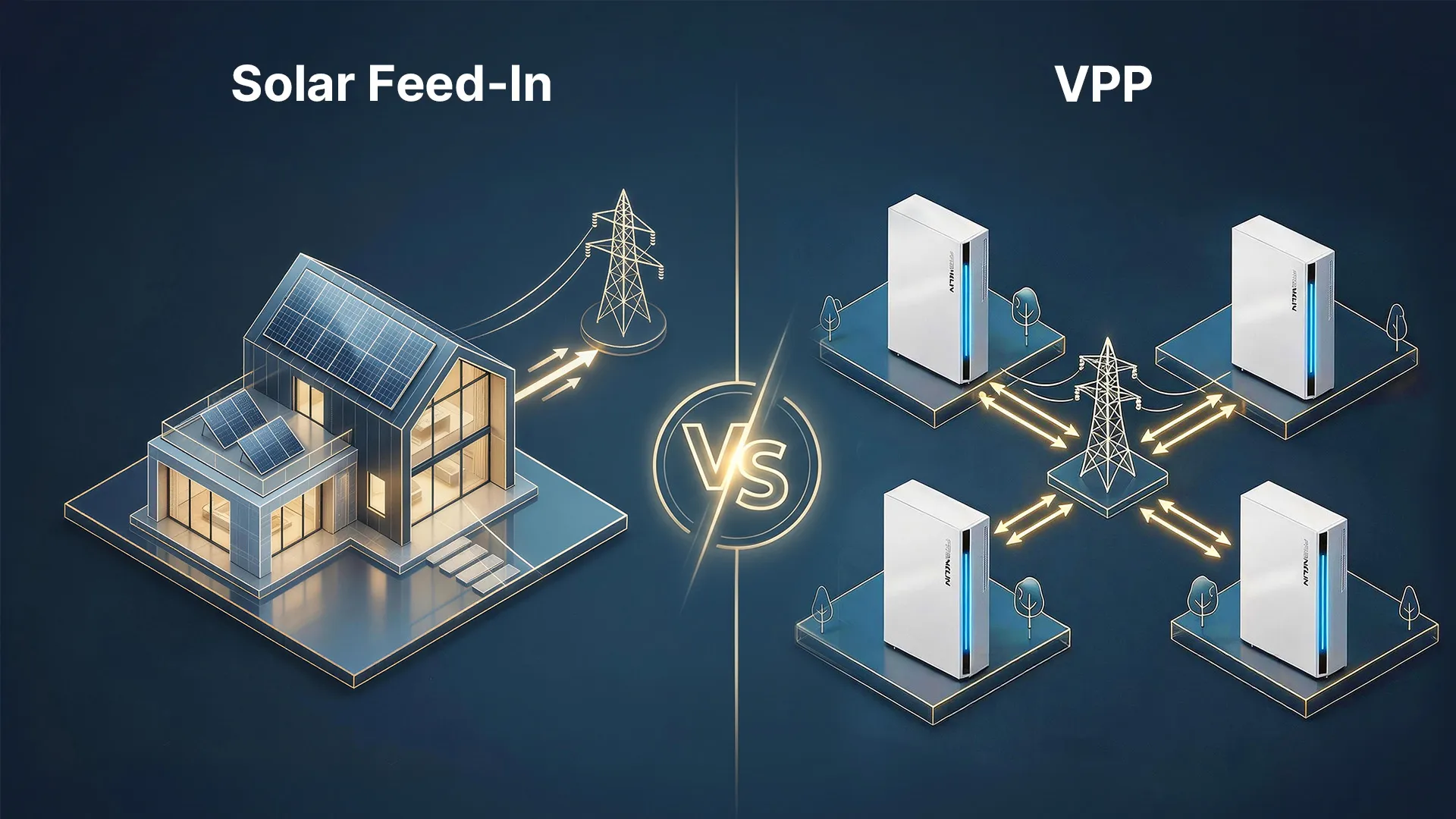
For homeowners with a home energy system combining solar generation and battery storage, surplus solar can be stored for future use, exported to the grid under a feed-in tariff, or shared through a Virtual Power Plant (VPP) to support the grid when demand peaks. Each option creates value in different ways.
This article explains how solar feed-in and VPP participation work, how they can complement each other, and what to consider when deciding which option produces greater value for their home.
How Solar Feed-in Tariffs Work for Home Battery Owners
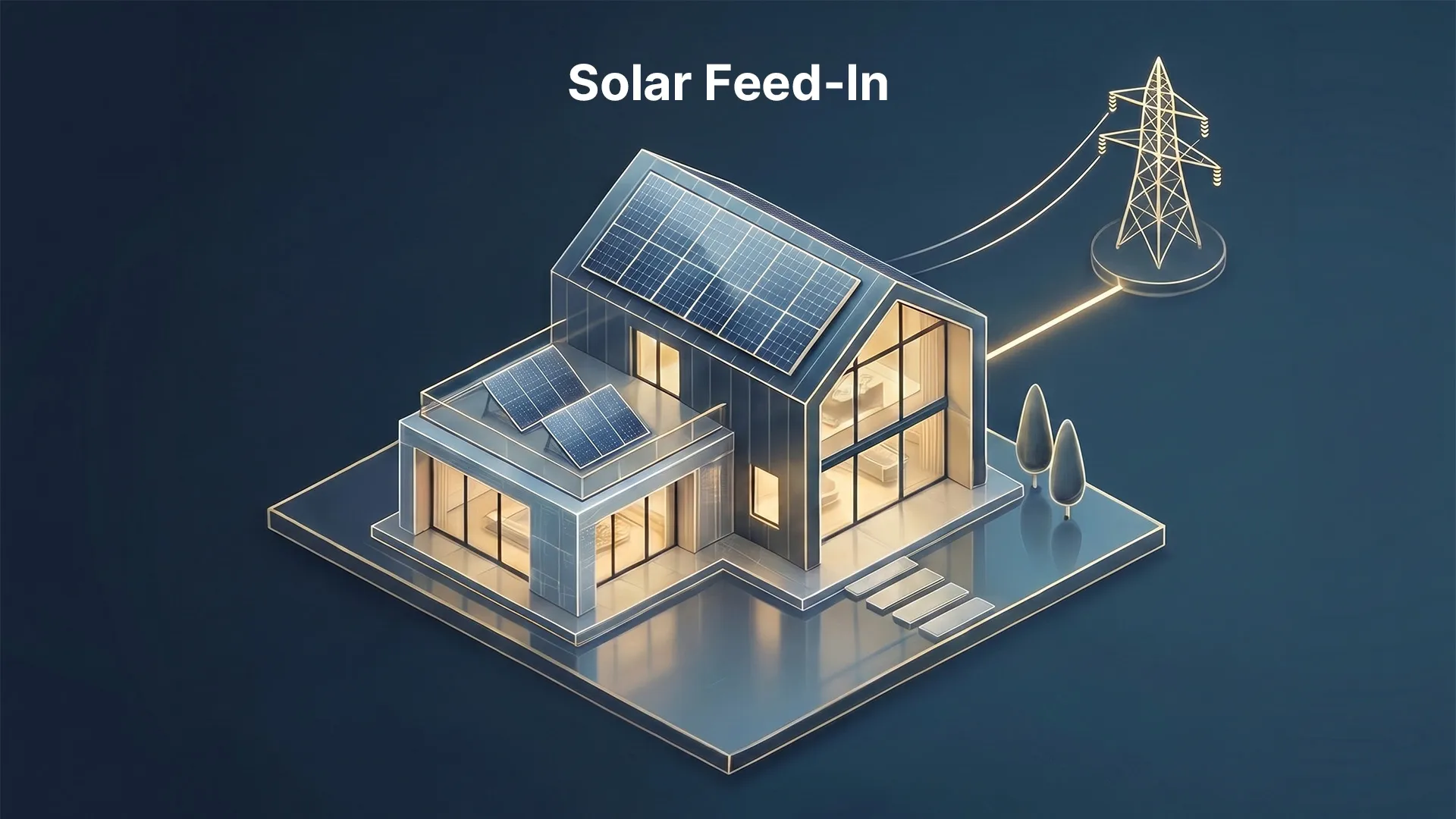
A solar feed-in tariff is the credit earned when surplus solar electricity is exported to the grid. For a typical home energy management and battery storage solution, solar power supplies the home first, charges the battery next, and any remaining energy is exported for a cents-per-kWh credit on the electricity bill.
In Australia, feed-in tariff rates vary by state, retailer, and electricity plan. They are not always set by the government. For example, NSW publishes a 2025–26 solar feed-in benchmark range of 4.8 to 7.3 cents per kWh, while Victoria no longer sets a minimum feed-in tariff from 1 July 2025, allowing retailers to set their own rates as long as they are not below zero.
How VPP Works for Home Battery Owners
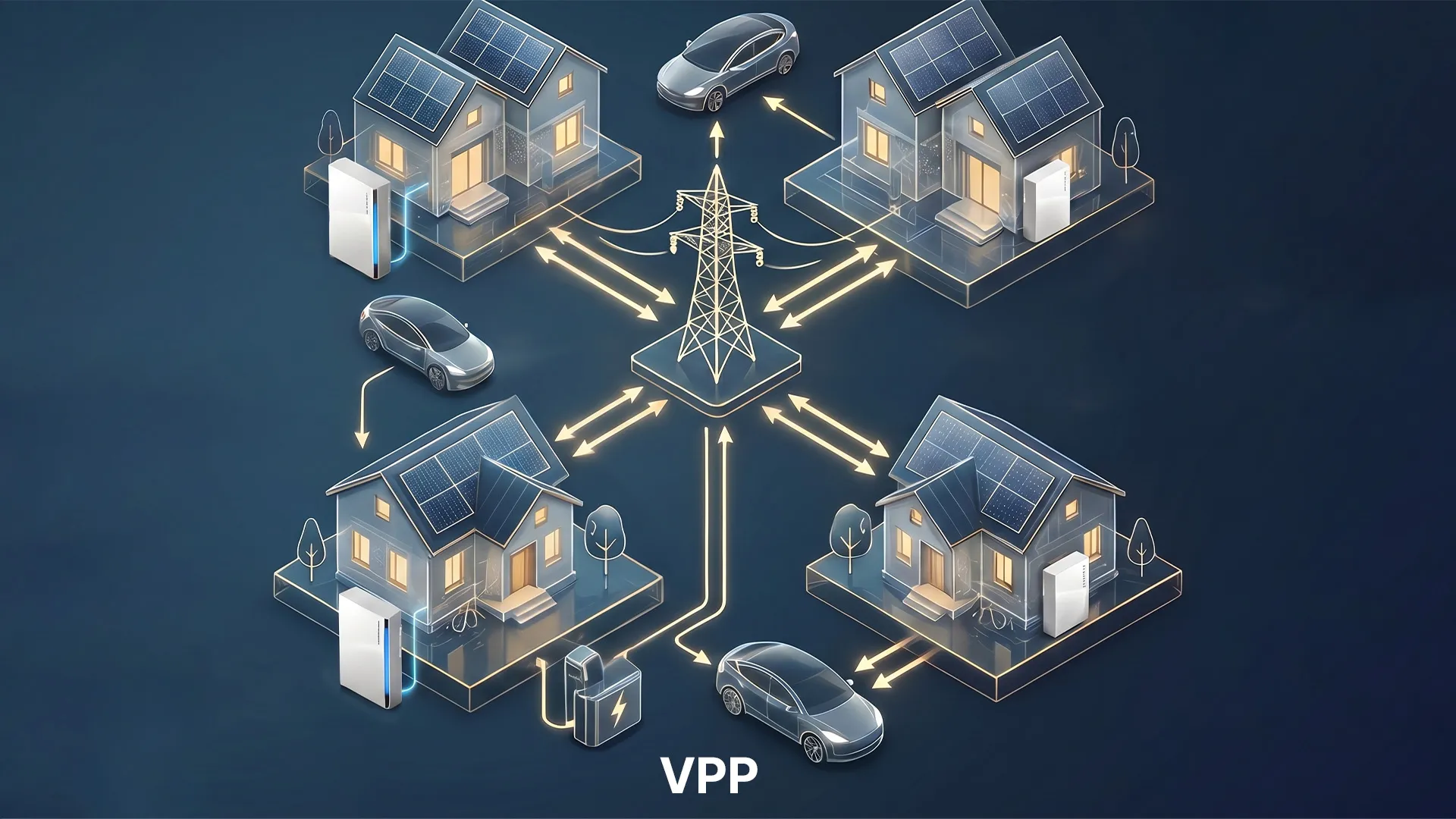
A VPP connects many home batteries through smart software communicating with the home energy management system, so they can operate as a coordinated energy resource. When enrolled, a battery in the system may discharge stored energy during peak demand or grid-support events.
For homeowners, this means the battery is not only used for storing solar and powering the home. With consent, the VPP provider can access part of the stored energy in the battery, deciding when to charge or discharge based on market needs, in exchange for bill credits, event payments, or other incentives.
VPP offers in Australia vary by provider, including payment structure, dispatch timing, and how much battery capacity is used. For example, Origin Energy’s Battery Lite offer connects eligible systems to Origin Loop, providing a $200 sign-up bonus and $1/kWh for battery exports during events, capped at 200 kWh per year.
Solar Feed-In vs. VPP: The Key Financial Differences
In 2026, for homeowners who have installed a home energy management system with battery storage, VPPs generally provide higher financial returns and faster payback than relying only on standard solar feed-in tariffs. While feed-in tariffs have fallen to relatively low levels (around 3–10 ¢/kWh), VPPs allow owners to export stored energy during peak periods for much higher returns, sometimes exceeding $1.00/kWh, or through consistent monthly credits. With a 15 kWh capacity and a lifetime throughput of 60 MWh, the FranklinWH aPower is estimated to generate an additional revenue of $7,200–12,600 through VPP participation, depending on the states, programs, and event frequency.
Why VPPs are Often More Financially Beneficial
VPPs can create additional value for home battery owners in several ways:
- Higher-value exports: VPPs reward battery exports during high-demand periods (e.g., early evening), when electricity prices are typically higher, not just when solar is generating.
- Access to incentives: In regions such as NSW and WA, joining a VPP may be required to qualify for certain state rebates and battery incentives.
- Automated earnings: Many VPPs use smart software to automatically dispatch the battery at optimal times, allowing homeowners to earn credits without manual intervention.
Why Feed-In Tariffs Might Still Appeal to Homeowners
Sticking with a feed-in tariff keeps things simple and gives you full control over your energy.
- Greater control: You decide when to use, store, or export your energy, so your battery is always ready when you need it most, particularly during outages.
- No lock-ins: There are no complex contracts or long-term commitments tying you to a single retailer.
- Longer battery life: Without frequent forced cycling from VPP dispatch events, your battery experiences less wear and is likely to last longer.
Quick Side-by-Side Comparison:
| Feature | Standard Solar Feed-In | VPP |
| Goal | Export excess solar to grid. | Coordinate energy for higher-value grid use. |
| Typical Returns | Low: around 3–15 ¢/kWh, varies by region. | High: often ≥ $1/kWh peak, depending on the VPP providers and plans. |
| Control | Full homeowner control | Partly controlled by the operator (automated). |
| Incentives | None or limited | May include rebates or bonuses. |

Key Considerations When Choosing Between Solar Feed-In and VPP Participation
- Value gap matters most: Using solar energy yourself typically saves around 35–50 ¢/kWh (avoided retail electricity), while exporting it via feed-in tariffs usually earns around 3–15 ¢/kWh. This makes self-consumption the most stable and consistent value source in most cases, so always prioritise home usage regardless of whether you join a VPP or not.
- Control vs. returns: If maintaining full control over your battery and energy usage is the priority, standard solar feed-in (or non-VPP battery plan) may be preferable, even if it offers lower financial upside.
- VPP + feed-in compatibility: Many VPP programs still allow participation in standard feed-in tariffs. When combined, they can improve overall earnings, depending on the program design and dispatch rules. This would be the most advised profiting option for a home energy management system with battery storage.
- System size matters: Smaller systems (<10 kWh usable storage) often see very limited VPP benefits due to reserve or operational constraints, while larger systems (10 kWh+) are better positioned to capture significant VPP incentives.
- Backup trade-off in VPPs: VPP participation may occasionally draw from your battery for grid events, potentially reducing backup availability. Ensure to set a minimum reserve (e.g., 20–30%) to maintain outage protection, especially in areas with unreliable grids.
Conclusion
While VPPs can offer higher long-term financial returns, solar feed-in tariffs give homeowners full control over when and how their battery energy is used. Importantly, the two are not mutually exclusive. In many markets, VPP programs operate alongside standard solar feed-in arrangements, allowing homeowners to export excess solar energy while also participating in VPP events when their system meets the program’s operating requirements.
For homeowners, combining both may deliver the best overall value, that is, prioritising the use of your energy locally first, using feed-in for surplus energy, and joining VPP events when incentives are attractive.
