


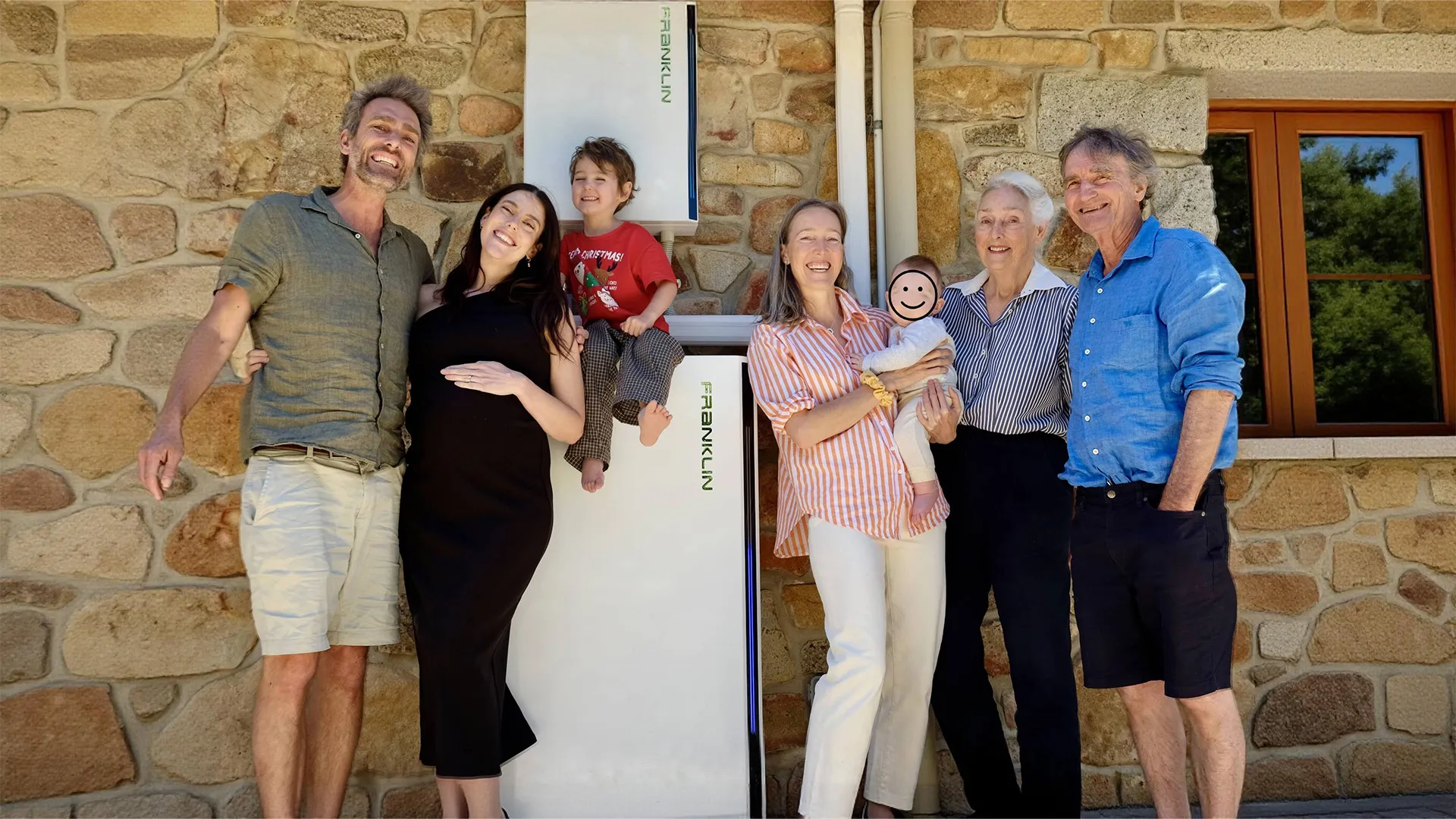
Mitch is FrankinWH’s Head of Product in Australia and New Zealand. He works with installers every day to improve outcomes for homeowners. He’s helped his sister and parents become part of the FranklinWH family.
Challenge
- Rising winter energy costs became a key concern for Mitch’s parents and sister as solar output declined while household demand increased.
- Lower winter solar generation made it harder to fully charge the battery through solar alone.
Solution
- Mitch helped his parents and sister switch to a new electricity provider offering a TOU plan with free electricity from 11 am to 2 pm, and a $1 evening no-import credit.
- The FranklinWH System uses TOU mode to charge its aPower X battery from solar and free grid power and shifts energy-intensive appliances to the free window with the Smart Circuits.
Result
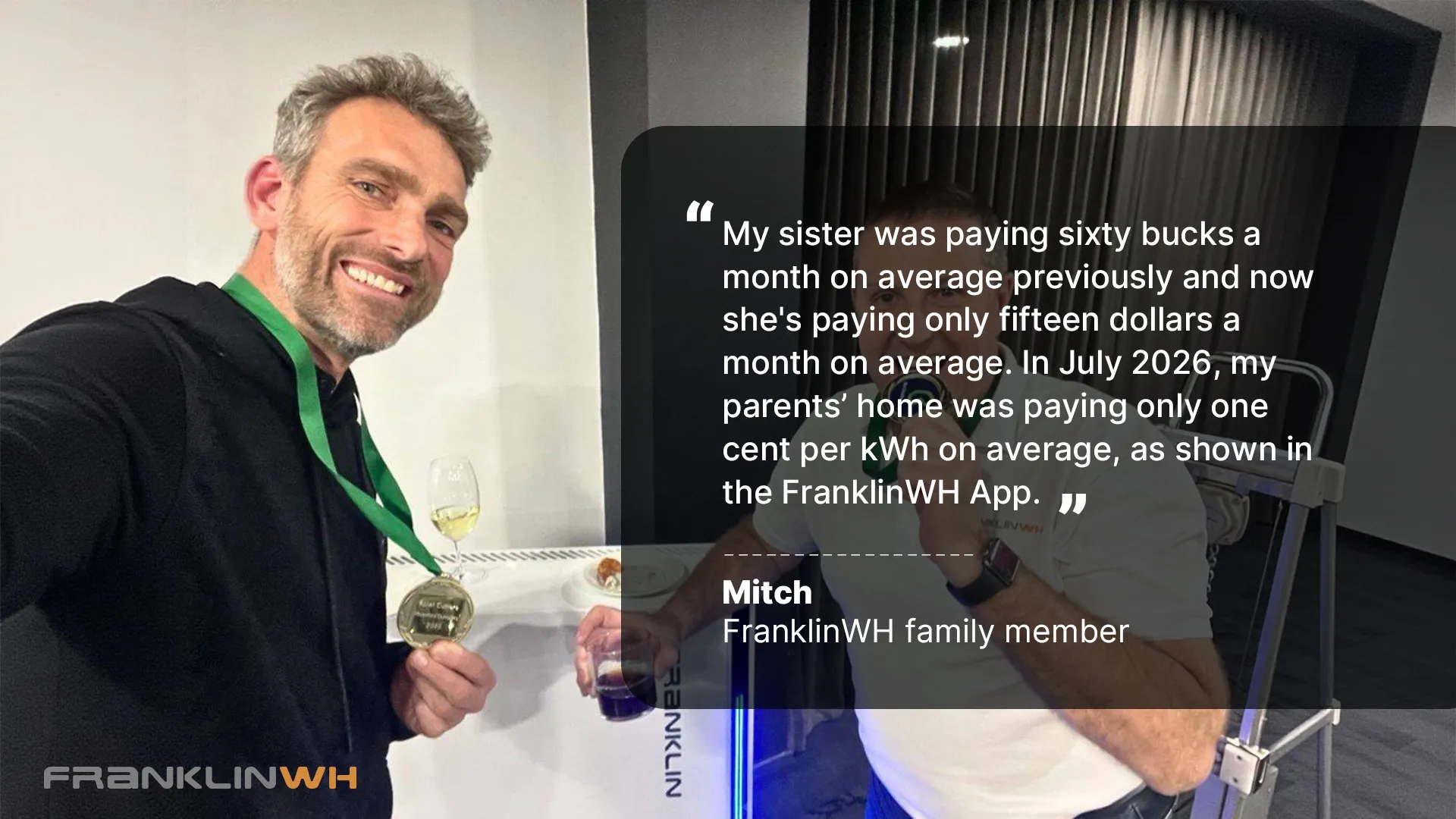
- Mitch’s sister cut her average monthly bill from about $60 to around $15 through the winter.
- Mitch’s parents reduced their winter bill from $250 per month to $60 per month.
Living in areas prone to extreme weather and extended outages, Mitch’s parents and sister faced the challenge of energy resiliency. Mitch helped them address this by adopting the FranklinWH System, an advanced home energy management and battery storage solution. However, as seasonal solar production, household energy demand, and electricity tariffs continued to change, a new challenge emerged: how to manage electricity costs through more effective energy optimisation.
Rising Winter Energy Costs and Lower Solar Availability
For Mitch’s parents and sister, the FranklinWH System was originally installed to hedge against serious power outages. “When a bushfire caused a grid outage that lasted 15 days this past summer, my parents were able to keep their home powered by solar and battery alone without any compromise to lifestyle,” Mitch recounted.
However, once the system was in place, the next challenge was how to use it more effectively to reduce everyday electricity costs.
During winter, their homes faced a common energy imbalance. Solar production dropped because of shorter days and reduced sunshine, while household electricity demand increased, mainly due to the heating demand.. “Although their legacy solar systems could provide valuable daytime energy, they were not able to generate sufficient surplus electricity to fully charge the battery in winter,” Mitch explained.
Their previous electricity plans did offer time-of-use (TOU) options, making it possible to charge the battery from the grid during cheap off-peak hours, but the arbitrage was not enough to make the practice worthwhile. The introduction of “free power” from the grid markedly tipped this equation and makes it a no brainer to get the batteries to 100% every day by 2 pm to avoid importing any costly evening power. Mitch pointed out that, “my parents and sister followed the same pattern, relying mainly on solar self-consumption.”
This worked better in summer months, when solar supply was much higher. In winter, however, the battery could remain undercharged, limiting its ability to offset the electricity that otherwise needs to be bought from the grid. As a result, the homes needed a smarter way to align battery charging and household consumption with the electricity pricing in a changing energy landscape.
Benefiting from Free Electricity While Meeting Advanced Winter Energy Needs
Australia’s large-scale rooftop solar adoption has reshaped the electricity market. With millions of homes exporting solar energy during the day, midday wholesale electricity prices can fall close to zero or even turn negative, creating room for retailers to design more creative tariff offerings. For families with a home energy management system, this changing landscape creates a valuable opportunity to significantly reduce their energy costs.
To capture that opportunity, Mitch helped his parents and sister switch to a new electricity provider with a more compelling TOU plan. The plan offers free off-peak electricity from 11 am to 2 pm and provides an $1 credit if the home avoids grid imports between 6 pm and 9 pm, with an enhanced feed-in tariff during the window. This encourages families to shift energy use into the free midday window and reduce peak evening demand. “The plan helps the retailer lower exposure to costly peak-period electricity purchases while giving customers a stronger incentive to cut their own bills,” Mitch noted.
With the FranklinWH System set to TOU mode, the battery can charge not only from rooftop solar but also from free grid electricity during the midday window. This helps ensure the battery reaches a full state of charge even in winter, when solar production is lower, so stored energy can completely cover evening usage and minimise reliance on peak-priced grid power.
By using the FranklinWH Smart Circuits, Mitch’s parents and sister can schedule energy-intensive appliances, such as hot water, to run automatically during the free electricity window, which further lowers overall energy costs.
Greater Savings Despite Less Sunshine
After switching to the new electricity provider, Both households were able to reduce their winter power bills by 75%. Their batteries were large enough to store enough energy to cover the evening demand so the only energy that was imported from the grid was free, leaving them with only the daily supply charge to cover on their bill and the $1 credit in the evening covered a significant portion of this anyway.
These savings were achieved despite weaker winter sunshine and without requiring major lifestyle changes. With the aPower battery in the FranklinWH System, free midday electricity can be stored and shifted to the evening when the families normally need more power for essential appliances. This means the families will not be forced to move essential energy use into the 11 am to 2 pm window just to benefit from free electricity.
The FranklinWH System automates charging, discharging, and the running of specifically selected loads with the Smart Circuits. For Mitch’s parents and sister, this creates a convenient, set-and-forget energy experience with minimal manual intervention.
Get the Most out of Your Investment in a Changing Energy Landscape
Electricity providers constantly design new offerings to maximise their own financial outcomes. For families, these changing plans and tariff structures can often have a significant impact on energy costs if their daily energy use remains unmanaged.
At the same time, the story of Mitch’s parents and sister shows that this changing landscape also creates new opportunities for greater savings. With an intelligent home energy management system, they can respond to new tariff offerings more effectively, allowing them to charge the battery to full reserve in winter using both solar and free off-peak electricity, then using that stored energy later when grid power would otherwise cost more. Mitch’s insights into both energy technology and market dynamics allows his family to get the best energy economics even when they are exposed to declining solar generation.
With engineered reliability and advanced, flexible software intelligence, the FranklinWH System is designed to stand the test of time. It helps families get the most out of their investment, even under less favourable solar conditions, by leveraging creative electricity offerings, keeping the battery better charged, and minimising expensive grid imports.